What separates students who get straight A’s from students who struggle to pass their classes? Is it a high IQ that pushes students to excel in their classes or is there something else? Angela Lee Duckworth, a teacher turned psychologist, has an answer to that question. After several studies conducted in the military, spelling bees, classrooms, and companies, Angela determined what causes people to excel. Simply put Duckworth says,
IQ was not the only difference between my best and my worst students.
In fact, she often saw cases in which students with higher IQ scores performed worse than students with lower IQ scores. So now we are back to our initial question–what separates students who get straight A’s from students who struggle to pass their classes?
Angela says grit is the separating factor. She defines grit as “passion and perseverance for very long-term goals”. Contrary to popular belief, grit has a more significant correlation to high school graduation rates than things like family income and social status do. So now you know you do not need to be some inherently intelligent individual to succeed in life, but how do you form grit?
Unfortunately, the answer is not easy and science does not have enough studies showing what actually builds grit, but on the bright side, we do not need to be talented individuals. Angela has observed cases where high talent could be inversely related to grit–in other words, the more talent one possesses, the less grit they may posses.
Additionally, Angela offers some hope from a study called “growth mindset” performed by Stanford’s Dr. Carol Dweck. Angela says the concept of growth mindset is, “the belief that the ability to learn is not fixed and it can change with your effort.” This means that if you failed to show grit in the past, you still have time to develop it.
Selepas melakukan beberapa penyiasatan, ternyata bahawa benih aprikot mengandungi vitamin B17. Semasa dirawat untuk kanser, saya akan mencari makanan yang juga mengandungi vitamin B17. Ternyata ubi kayu mempunyai vitamin B17. Jadi saya makan 10 gram ubi kayu tiga kali sehari.
Setelah makan ubi kayu selama sebulan, doktor saya memeriksa pundi kencing saya untuk kanser. *Dia terkejut kerana pundi kencing saya benar-benar bersih dan normal.*
Selagi saya terus makan ubi kayu, saya rasa sangat sihat dan sihat. Setiap tiga bulan saya akan pergi untuk pemeriksaan dan keputusan saya tetap bersih. Sejak itu, saya hanya makan ubi kayu dan tidak meneruskan ubat kanser lain.
Ringkasan kandungan aktif vitamin B17 dari ubi kayu adalah:
Nama saintifik vitamin B17 ialah Amygdaline. Sel-sel kanser adalah sel yang tidak matang, mempunyai enzim yang berbeza berbanding dengan sel normal.
Apabila vitamin B17 digabungkan dengan enzim sel normal, B17 akan berubah menjadi 3 jenis gula. Tetapi apabila digabungkan dengan enzim sel kanser, B17 bertukar menjadi 1 gula, 1 benzaldehida dan 1 asid hydrocyanic. Asid hidrosianik ini membunuh sel kanser secara tempatan. Biji aprikot dan *ubi kayu mengandungi vitamin B17.*
En. Pereira, seorang lelaki berusia 70 tahun, didiagnosis dengan kanser prostat. Isterinya di hospital berlaku untuk membaca artikel saya. Mereka tidak mempunyai wang untuk rawatan kanser dan suntikan yang diberikan membuat Mr.Pereira sangat lemah. Isterinya memberikan ubi kayu Mr. Pereira untuk dimakan. Selepas makan ubi kayu selama seminggu, keadaannya mula menjadi lebih baik. Dan selepas sebulan makan ubi kayu setiap pagi, keputusan ujian PSAnya meningkat dari 280-290 menjadi 5.89! Mereka melawat saya untuk menunjukkan keputusan ujian sebelum dan selepas makan ubi kayu. *Pereira tidak mempunyai tanda-tanda kanser selepas terus makan ubi kayu.*
Ada orang lain yang mempunyai kanser hati dan terpaksa menjalani pembedahan. Tetapi dari hasil imbasan MRI, terdapat sel kanser masih wujud. Jadi, dia mula makan ubi kayu selepas pembedahan. *Sebulan selepas makan ubi kayu atau ubi kayu, doktor memberitahu dia tidak perlu menjalani pembedahan lagi kerana imbasan MRI tidak menunjukkan apa-apa sel kanser hadir di hati.*
🙋🏻♂ *Jadi kenapa tidak cuba ubi kayu untuk mengubati kanser?* Ia murah, mudah untuk dimasak, dan sangat lazat. Ia sangat mudah:⤵️
_*1. Pilih ubi kayu yang segar yang tidak mempunyai warna kebiruan pada permukaannya.*_
_*2. Rebus dan jangan menutup kuali semasa masak. Ini akan membantu mengeluarkan asid midrosianic berlebihan.*_
_*3. Semasa makan ubi kayu, jangan makan makanan halia / halia, seperti biskut halia, bir halia, gin pada masa yang sama.*_
Saya akan menggalakkan semua orang membaca artikel di atas. Saudara saya sendiri 2 bulan pergi untuk memeriksa PSA dan 2000, mereka memeriksa semula dan 3000. Kakak saya dipanggil untuk memaklumkan. Perkara pertama yang kami lakukan adalah berdoa. Saya teringat di atas artikel seseorang telah menghantar saya. Saya mengemukakannya kepada kakak saya. Dia mencubanya pada adik saya. Selepas bulan makan ubi kayu, PSA beliau menurun dari tahun 2000 ke 6.65. Dia telah mengulangi PSA pada 28/05/2018 dan PSA beliau 0.63.
Assalam posting 19 Jun 2019 dalam grup ini, ulang posting moga membantu. In Shaa Allah.
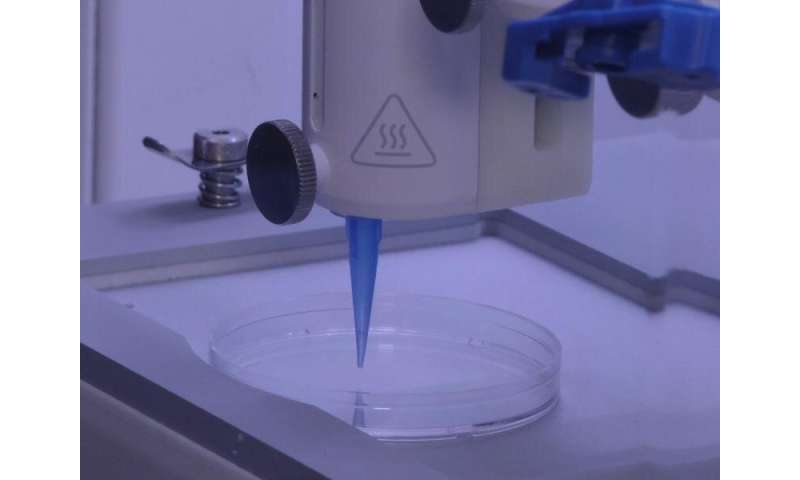
Researchers at Rensselaer Polytechnic Institute have developed a way to 3-D print living skin, complete with blood vessels. The advancement, published online today in Tissue Engineering Part A, is a significant step toward creating grafts that are more like the skin our bodies produce naturally.
Ad
”Right now, whatever is available as a clinical product is more like a fancy Band-Aid," said Pankaj Karande, an associate professor of chemical and biological engineering and member of the Center for Biotechnology and Interdisciplinary Studies (CBIS), who led this research at Rensselaer. "It provides some accelerated wound healing, but eventually it just falls off; it never really integrates with the host cells."
A significant barrier to that integration has been the absence of a functioning vascular system in the skin grafts.
Karande has been working on this challenge for several years, previously publishing one of the first papers showing that researchers could take two types of living human cells, make them into "bio-inks," and print them into a skin-like structure. Since then, he and his team have been working with researchers from Yale School of Medicine to incorporate vasculature.
In this paper, the researchers show that if they add key elements—including human endothelial cells, which line the inside of blood vessels, and human pericyte cells, which wrap around the endothelial cells—with animal collagen and other structural cells typically found in a skin graft, the cells start communicating and forming a biologically relevant vascular structure within the span of a few weeks. You can watch Karande explain this development here.
"As engineers working to recreate biology, we've always appreciated and been aware of the fact that biology is far more complex than the simple systems we make in the lab," Karande said. "We were pleasantly surprised to find that, once we start approaching that complexity, biology takes over and starts getting closer and closer to what exists in nature."
Once the Yale team grafted it onto a special type of mouse, the vessels from the skin printed by the Rensselaer team began to communicate and connect with the mouse's own vessels.
That's extremely important, because we know there is actually a transfer of blood and nutrients to the graft which is keeping the graft alive," Karande said.
In order to make this usable at a clinical level, researchers need to be able to edit the donor cells using something like the CRISPR technology, so that the vessels can integrate and be accepted by the patient's body.
"We are still not at that step, but we are one step closer," Karande said.
"This significant development highlights the vast potential of 3-D bioprinting in precision medicine, where solutions can be tailored to specific situations and eventually to individuals," said Deepak Vashishth, the director CBIS. "This is a perfect example of how engineers at Rensselaer are solving challenges related to human health."
Karande said more work will need to be done to address the challenges associated with burn patients, which include the loss of nerve and vascular endings. But the grafts his team has created bring researchers closer to helping people with more discrete issues, like diabetic or pressure ulcers.
"For those patients, these would be perfect, because ulcers usually appear at distinct locations on the body and can be addressed with smaller pieces of skin," Karande said. "Wound healing typically takes longer in diabetic patients, and this could also help to accelerate that process."
More information: Tânia Baltazar et al, 3D bioprinting of a vascularized and perfusable skin graft using human keratinocytes, (...), Tissue Engineering Part A (2019). DOI: 10.1089/ten.TEA.2019.0201
As someone who has interviewed probably thousands of job candidates in my career, I’ve long been surprised by how many people don’t ask good questions when their interviewer gives them the opportunity. A surprising number of candidates don’t have many questions at all, or simply use the time to try to further pitch themselves for the job. To me, this is crazy — after all, this is a job that you’re considering spending 40 or more hours at a week, a job that might have a huge impact on your career and your quality of life for years to come. You should have questions!
1. “How will you measure the success of the person in this position?”
This gets right to the crux of what you need to know about the job: What does it mean to do well, and what will you need to achieve in order for the manager to be happy with your performance?
If no one has stayed in the job very long, that could be a red flag about a difficult manager, unrealistic expectations, lack of training, or some other land mine. If just one person left after a few months, that’s not necessarily a danger sign — after all, sometimes things just don’t work out. But if you hear there’s been a pattern of people leaving quickly, it’s worth asking, “Do you have a sense of what has led to the high turnover?”
5. “What are you hoping this person will accomplish in their first six months and in their first year?”
This question can give you a sense of what kind of learning curve you’re expected to have and the pace of the team and organization. If you’re expected to have major achievements under your belt after only a few months, that tells you that they likely won’t give you a lot of ramp-up time. Which might be fine if you’re coming in with a lot of experience, but it might be worrisome otherwise. On the flip side, if you’re someone who likes to jump right in and start getting things done, you might not be thrilled to hear that most of your first six months will be spent in training.
Plus, the answer to this question can give you much more nuanced insight into what it’ll take to truly excel in the job — and whatever the answer is, you can think about whether or not it’s something you’re likely able to do.
7. “How would you describe the culture here? What type of people tend to really thrive here, and what type don’t do as well?”
If the culture is very formal with lots of hierarchy and you’re happiest in a more relaxed environment, this might not be the right match for you. Similarly, if it’s a really competitive environment and you’re more low-key, or if they describe themselves as entrepreneurial and you prefer structure, it might not be an ideal workplace for you. If you don’t have a lot of other options, you still might decide to take the job anyway — but you’ll usually be happier if you know what you’re signing up for, and aren’t unpleasantly surprised after you start.
9. Ask the question you really care about.
Sometimes people use their turn to ask questions in an interview solely as an additional chance to try to impress their interviewer — asking questions designed to reflect well on them (by making them look smart, thoughtful, or so forth) rather than questions designed to help them figure out if the job is even right for them in the first place. It’s understandable to want to impress your interviewer, but interviewing is a two-way street — you need to be assessing the job and the employer and the manager, and figuring out whether this is a job you want and would do well in. If you’re just focused on getting the job and not on whether it’s the right job for you, you’re in danger of ending up in a job where you’re struggling or miserable.
Of course, you shouldn’t rely only on your interviewer’s answers about these things. You should also do due diligence by talking to people in your network who might have the inside scoop on the company’s culture or the manager you’d be working for, reading online reviews at places like Glassdoor, and talking to other people who work there.
10. “What’s your timeline for next steps?”
This is a basic logistics question, but it’s useful to ask because it gives you a benchmark for when you can expect to hear something back. Otherwise, if you’re like many people, in a few days you’re likely to start agonizing about whether you should have heard back about the job by now and what it means that you haven’t, and obsessively checking your phone to see if the employer has tried to make contact. It’s much better for your quality of life if you know that you’re not likely to hear anything for two weeks or four weeks or that the hiring manager is leaving the country for a month and nothing will happen until she’s back, or whatever the case might be.
"Allah!
None has the right to be worshipped but He, the Ever Living, the One Who
sustains and protecs all the exists. It is Who has sent down the Book (Al
Quran) to you with the truth, confirming what came before it, and He sent
down the Taurat (Torah) & the Injil (Gospel)."(Surah Ali
Imran: 2-3) "And We have
sent down to you the Book (Al Quran)as an exposition of everything,
have submitted themselves (to Allah as Muslims)." (Surah
an-Nahl: 89)
HEALTHY BODY AND SOUL
Information on solving personal health . Save yourself and save the world








 "Allah!
None has the right to be worshipped but He, the Ever Living, the One Who
sustains and protecs all the exists. It is Who has sent down the Book (Al
Quran) to you with the truth, confirming what came before it, and He sent
down the Taurat (Torah) & the Injil (Gospel)."
(Surah Ali
Imran: 2-3)
"Allah!
None has the right to be worshipped but He, the Ever Living, the One Who
sustains and protecs all the exists. It is Who has sent down the Book (Al
Quran) to you with the truth, confirming what came before it, and He sent
down the Taurat (Torah) & the Injil (Gospel)."
(Surah Ali
Imran: 2-3)


